
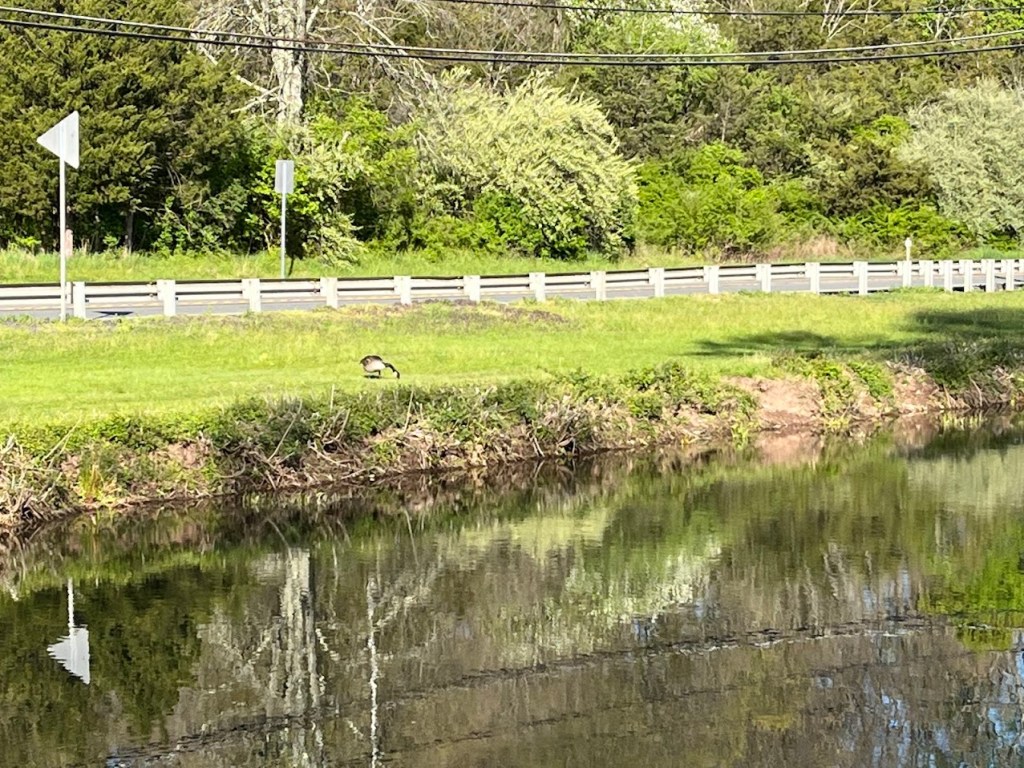
This past April, my sister Chris was visiting me in New Jersey for a few days, and we took one of our usual walks together down near the Delaware River in Titusville. We walk and talk while listening to the birds, enjoying the river’s scenic vistas, and greeting people walking their dogs. This time we decided to do a slightly alternative loop and come back along the canal path. Along the way, we noticed a goose standing on the other side of the canal in the grassy area all alone. We wondered why he was so firmly rooted in his spot, when I noticed another goose near him nestled in the banks of the canal sleeping. Oh..! I exclaimed to Chris, and pointed this out. They are nesting! We stopped, hushed, and pondered the beautiful respite of the sleeping goose and her partner keeping watch, and quietly walked on our way.
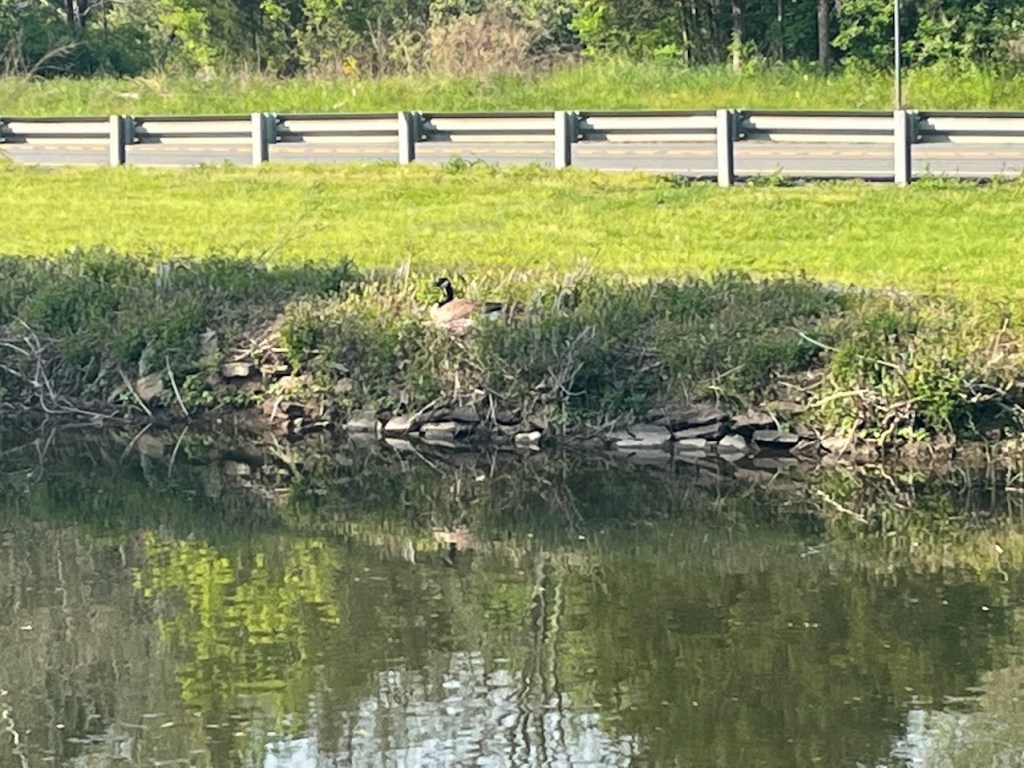
I have lived along the Delaware River for over 30 years. I see Geese all the time on and along the river, and hear their significant and distinctive honks as they fly overhead in the fall, and of course I notice their goslings in the spring. (I also try to avoid their poop in the grass). But I have never noticed a nesting pair before in such plain sight in our area along the canal. After Chris went back home, I kept the routine of this same route on my daily walks, checking in on the patrolling Dad keeping watch, and the Mama Goose who so dutifully carried out her responsibility on the nest. I read that the female does not ever leave the eggs, not even to eat, until they are hatched. I found this very compelling, and I became totally invested in this pair of Geese. When I went away for a weekend, or I didn’t walk down there for a day or two, I worried – were they OK? Was the nest going to make it? Would their babies hatch?
Sometimes Dad Goose would be in the water, swimming back and forth. Sometimes he was on the grass, pacing or nibbling. Once I didn’t see him at all, and I did some pacing myself along the canal looking for him.
Since we weren’t sure exactly when they had nested, I wasn’t sure when to expect to watch for the babies. My research told me that it was about 28 days for the eggs to hatch, so in early May I was extra vigilant. I had my neighbors equally invested, and my husband even made a trip down to check on them and report back to me while I was away for a work trip. Chris and I texted frequently. How are the geese doing? Fine, I would say… saw the Dad swimming today.
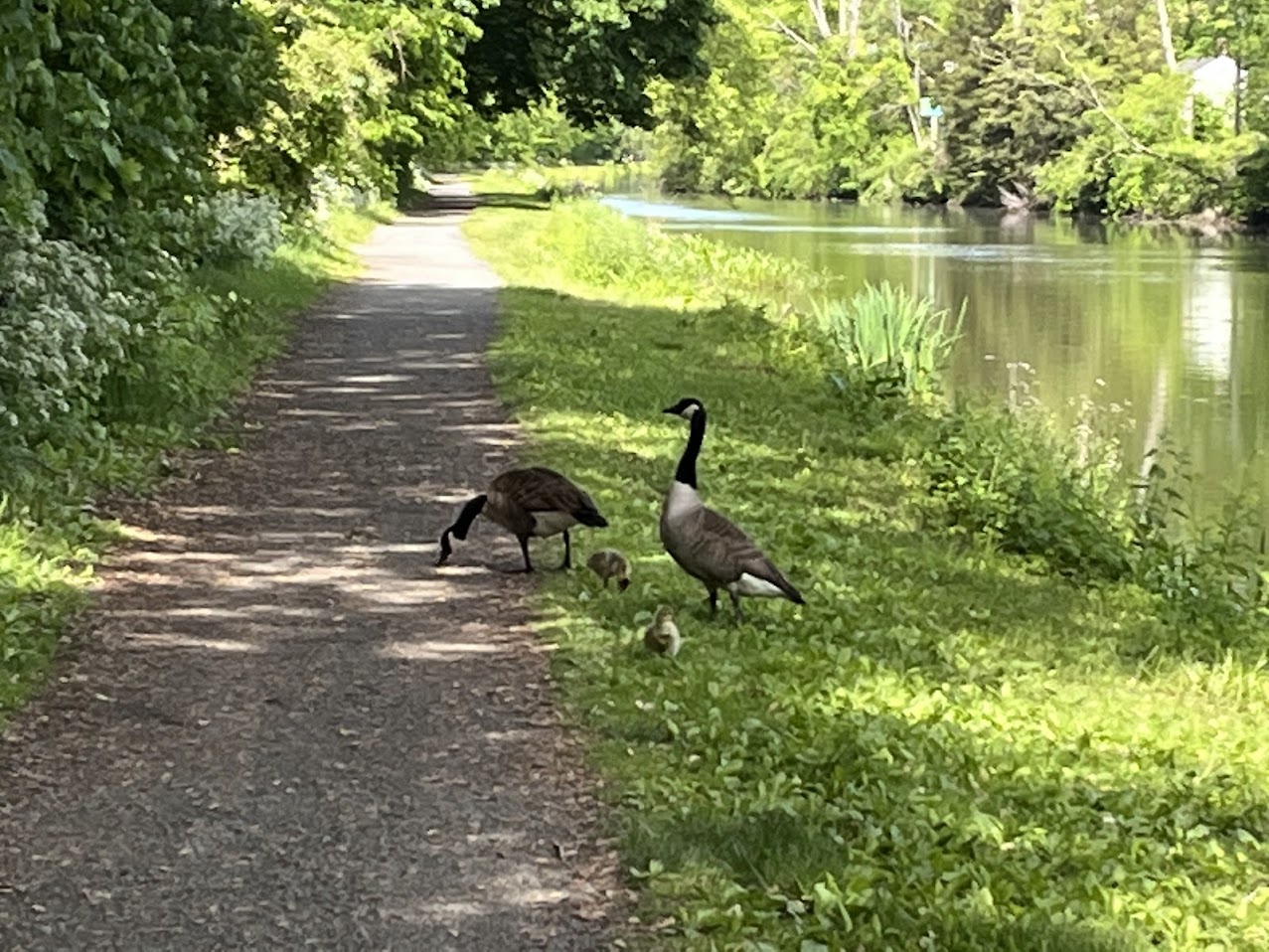
One day, I noticed Mama Goose was no longer in the area where the nest was, and since it’s across the canal from the path, I couldn’t see much of it, though I noticed some feathers and disturbance in the grass. But I saw no evidence of the parents anywhere, which led me to wonder if they had abandoned the nest, or if some predator had gotten the eggs. Then, right before Mother’s Day, on one of my regular walks, a little voice told me to go the other direction on the canal path, which I did. Behold, these two geese walked up the banks in front of me with their two babies! They had made it! It was as if they were showing them off to me – I know, it seems ridiculous, but did I mention I was invested? It was a great Mother’s Day present.
My actions led me to wonder why I had spent so much time thinking and worrying about these geese this particular nesting season. What had changed in me to be so reflective about nature’s habits and plans, and most of all, these geese that are always present, but somehow now I suddenly see differently?
Along these same lines, I have vacationed in New Hampshire on Squam Lake since I was a very young child, and we have continued going up there with our kids over the past 25 years. I have long been fascinated by the Loons on Squam, their beauty, their behavior, their repertoire of various calls, and their habits in nesting and raising chicks together. When I was growing up in the 1970’s, loons were endangered, and we learned to respect them, watch our boat speed when we saw them in the water, and I would fall asleep to the sounds of their haunting wails on the lake. Last summer I made a visit to the Loon Preservation center, and I frequently go the Biologist’s talk every year at Rockywold Deephaven Camps where we stay. There is something compelling about them, but more recently, I have become more emotionally empathetic to their struggles in nesting and raising chicks together. It is very fraught.
I am at the time in my life, where I have not quite an “empty nest” – but I would say more of a “hybrid” nest. My kids are sometimes home, sometimes not, for varying periods of time. My son is still in college. I have joked with friends about the empty nest, is there such a thing? I remember my older brothers came and went frequently in our house as I was growing up, coming to live there for periods of time after they had graduated college. My husband Joe and I sort of brushed off the term “empty nesters” as a label, as it sounded sort of sad and hollow. Aren’t we still people with kids whether or not they happen to be living with us?
But I think what I have come to realize at this stage, is I now find some comfort in the pragmatism of nature and these parents in the wild. There is so much out of their control, and they do their best. Sometimes loons on squam have a successful nest, and raise their chick to fledge, but sometimes the nest gets flooded or the eggs don’t hatch, and they just move on, and try again the next year. When they are threatened, they defend their territories, and sometimes they are successful, and sometimes not, and they have to move on to a different part of the lake, or in some cases, a new lake altogether!
In this “hybrid” nest phase of my own human parenting, I am recognizing that I am looking for parallels with these birds of nature, and perhaps a few lessons or nuggets of comfort contained in their life cycle and struggles. There is a commonality in that we are all just trying to take care of our babies. These days with my more adult kids, I find myself a little more conflicted or unsure when to step in to help, when to take a few steps back, when to offer advice, and when to just shut up. I am aware that in our generation of parenting, we often try to fix too many things, hovering, when our kids are quite capable of managing on their own. Or if they are not, they will have failures and learn how to recover from them. My parents did not assist me with college course selection, or edit my essays, and were definitely more hands off. But they were present and available. They didn’t do everything right, I don’t do everything right, but we are there, trying.
This past week, my sister and I watched with bated breath and nervous anticipation as the “Loon Cam” livestream in the NH Lakes region showed a loon chick hatching. It was amazing, and fascinating to get a glimpse into this cycle of life for them on their nest. This little feisty chick kept peeping and following its parents dutifully, as well as surviving them literally stepping on it as they would get on and off the nest – (loons are not very graceful on land and need to be in the water!) At one point the chick got stuck in the netting of the nest as it tried to hop its way into the water, and all the people watching together on the Live chat were getting very nervous. The mom Loon was off the nest swimming, (and wouldn’t have been able to help anyway), but thankfully the chick figured itself out before flopping into the water to catch up to her.
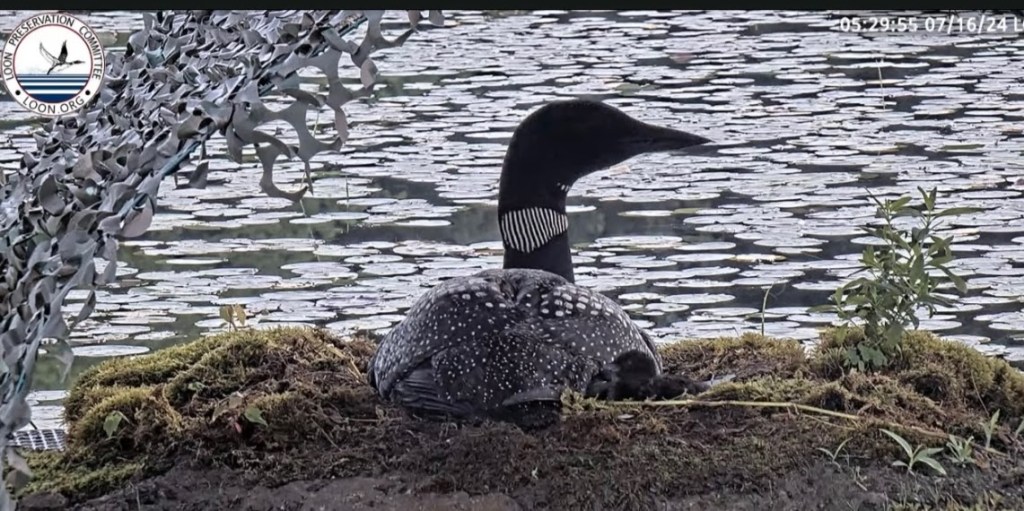
Loon on nest with baby chick 
First swim!
I am a fairly pragmatic person, but I have had more reflection time (questioning time?) with this particular phase of life, and parenting. So perhaps for me, it’s just a lesson and a reminder in seeing these beautiful instinctual mamas in the wild who raise their babies, but literally do not try to fix anything. They just let them figure it out. For them, it is often a matter actual life and death survival – and the stakes are higher. So, if they can do it, I have faith that I can do it too.
And now my sister and I have a thread of somewhat hilarious and also heartfelt texts with accompanying photos from my goose reporter beat about the Geese (and the loons) where we are kind of both simultaneously sobbing and also being cheerleaders for the outcomes:
Geese Reporter on duty – update from my beat. Goslings are growing up!
I must say they grow like weeds!
There is a whole community of geese by the canal…! They all seem to be co-parenting. Haha. I think there is a bunch of bachelors that are all hanging out together.
Look at how big they are getting! We’ll be putting them through college.
We’d also better get them started with folding laundry.
They are such good parents!
 One Leg Up
Hi Annie-It’s your old friend Janice Gossman. This beautiful piece that you wrote, popped up in my email inbox this morning! Maybe that is a nudge from the universe for me to finally get in touch with you after all these years that have whipped by since I last saw you at the gathering in Pennington to celebrate the life of your mom. A few summers ago, I retired from 31 years of teaching to move with Mike to Kingston in order to live near my mom. Last August, she moved into Brandywine, an assisted living facility a few miles away from us. My dad died in January 2021.
Mike and I love Kingston. We live a short walk from the toe path along Carnegie Lake (so I can relate to what you wrote about connecting with the geese). You probably still go to work, and have a more structured and full schedule than I do, but if you have any open pockets of time, I would really love to catch up with you. My email is stormkinger@msn.com, and my phone number is (908)317-9376. And my cell phone number is 908-358-8345. I would love you to come and visit our house in Kingston- built in 1880!!! It’s right near the center of town, near the Kingston Garage.
Love to you, Joe, Shannon, and Joseph,
Janice