
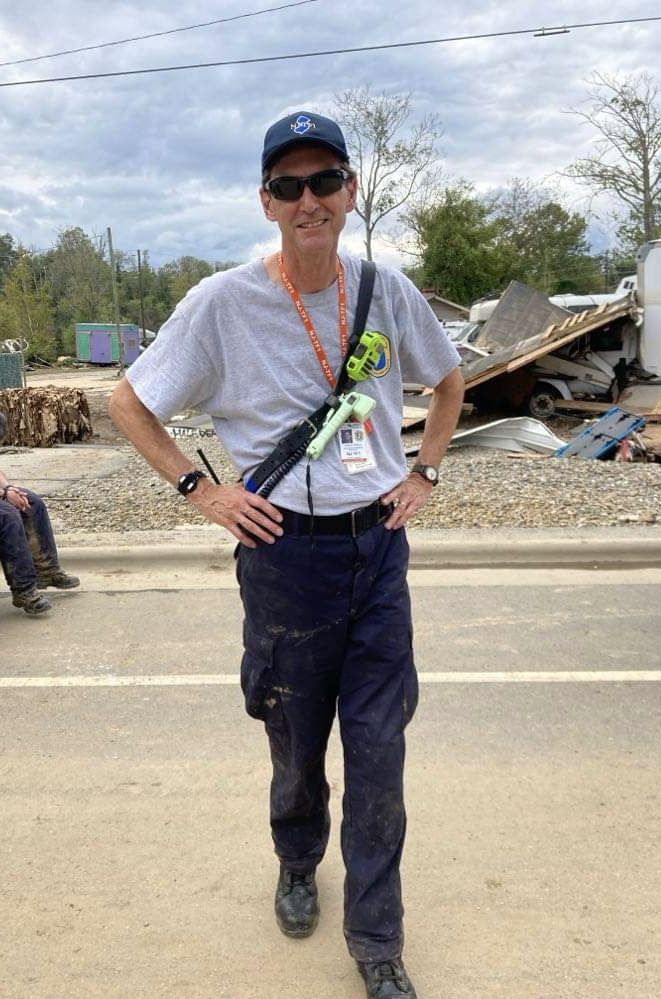
This September, as with many previous Septembers over the last decades, Joe was “on call” for New Jersey Task Force 1 (NJTF-1) for hurricane response. We are going on 30 plus years of doing this dance in our house, as he has been a first responder for all of our married life, and has been on many deployments for hurricanes in the last 25 years, including the devastating Hurricane Katrina in 2005.
I have always talked about this with family and friends, and I felt people were fairly informed about what this work was and why he was committed to it. (Even after his “retirement” from West Windsor Emergency Services two years ago). I was struck this time around by how my “outer circle” (not necessarily my inner circle of close friends or family members) didn’t know, or maybe just hadn’t paid attention to, what New Jersey Task Force 1 was, or what it is they do exactly. And for this particular event, since it was so high profile, I won’t go so far as to say that people wondered if he was just driving down to North Carolina in his car to help (maybe not that extreme…) but I was definitely fielding more questions.
In the spirit of giving these dedicated first responders more visibility, after so many years as a pragmatic wife actively watching these deployments, and getting some information from family “debriefs” afterwards, I decided to interview Joe. (What could possibly go wrong?) Armed with new tools to record and transcribe our discussion, and a notepad of my hand-crafted questions, both personal in nature, and questions a larger audience would ask, I did my best journalist impression. We sat together on our couch (with our cats, naturally), and talked about Asheville, NJTF1, training tactics, comparisons to Hurricane Katrina, and many other insights about their work. In 30 years, I will say I have picked up some nuggets of information, but I learned even more in this conversation.
Here’s how it went.
Me: Give me your best elevator speech about what NJTF1 is and what it is you do, exactly.
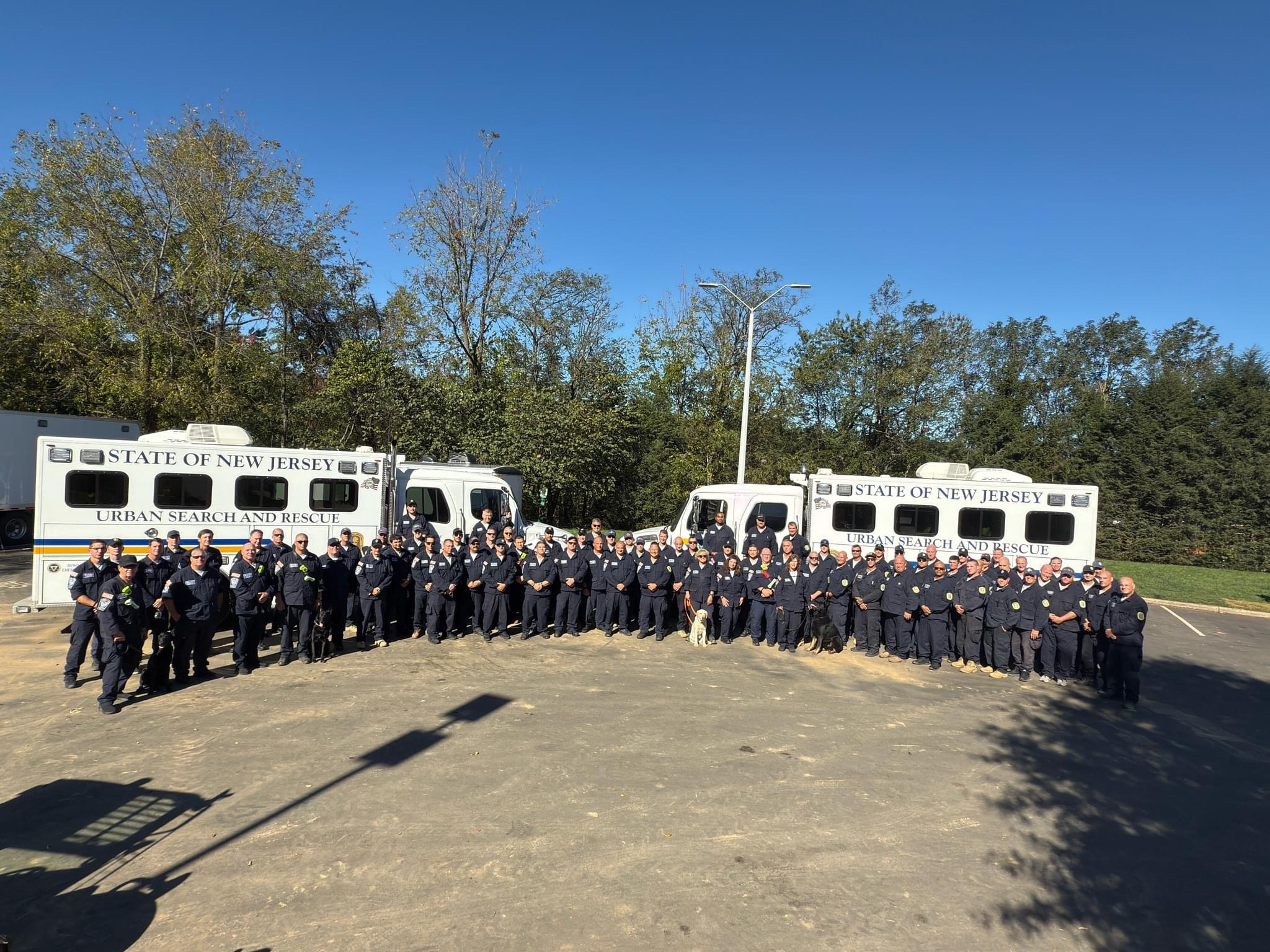
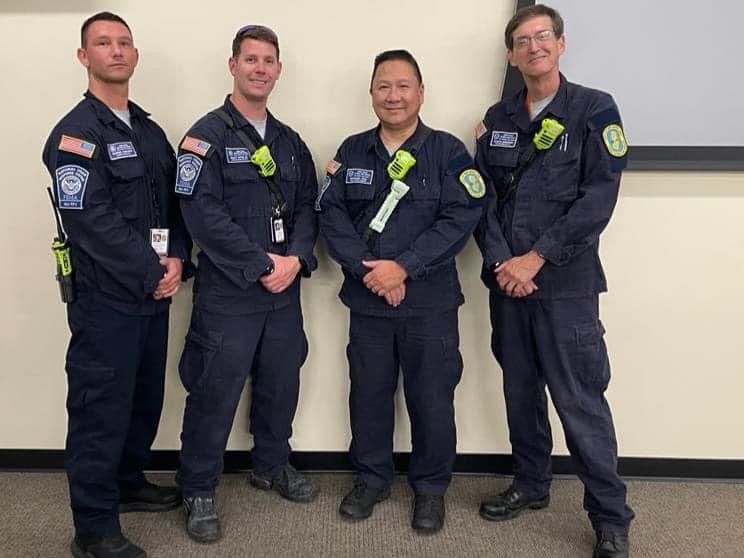
Joe: New Jersey Task Force 1 is a group that has existed since before 9/11, actually one of the first structural collapse teams to go to the World Trade Center on 9/11 was NJ-TF1. There are now 28 FEMA USAR teams that specialize in major building collapse. The kind of damage that would overwhelm local resources and fire departments. The teams are made up of many components – the rescue component is the largest (very elite) and supporting them are a planning group, a logistics group, a search group, including trained search dogs, a communications group, a medical group and the hazmat group. I am in the hazmat group. The job of hazmat is to make sure that there’s nothing that’s going to harm our team and that they will be able to work. Imagine if an entire building collapses, with everything in the building mixes together. Surfside Towers is probably the most recent large example of that. Everything that is underneath your kitchen sink comes together and creates harmful gasses. In my component, it’s our job to answer two questions – can the rescue group work there, or can they not work there? If we determine that there is some kind of danger – chemically, we have to come up with a fix so that rescuers can work there.
The problem is not going away. We have to figure that out. One of the hazmat component’s first jobs, when we get to a collapse site, is to go out with the original recon and dogs to identify any hazards. Chemical hazards that could be harmful to people or the search dogs are identified by hazmat. The second skillset is water rescue. The members trained in water rescue come from any of the components.
Me: Kind of a long elevator speech – but we’ll just say we were riding to the top of the Empire State building. What is the average length of experience for the members of NJTF1?
Joe: 15 years is probably the least experience. There are 240 people on the team, the State of New Jersey has a lot of fire departments, police and rescue squads. We have the cream of the crop of those. NJ-TF1 existed as a state team before we were picked to fill an empty FEMA USAR team slot. We had trained like FEMA USAR teams prior to this. It was an easy transition.
Me: Just to clarify, not all 200 plus people are deployed at the same time.
Joe: No, only ever one third of the team goes out. A “type 1 team” which was deployed for Hurricane Helene is 80 people. Every month the “Red” “White” or “Blue” team is up, and we rotate.
When we went to North Carolina, our mission was split into two rescue modes. It was known Asheville was going to be hit by the remnants of the storm, with a lot of tornadoes and severe weather as a probability. So, half the group concentrated on the water rescue, and the other half of the group concentrated on elements like trees into buildings, and helping the Asheville Fire Department out with the probability that tornadoes were going to come through. Our team ultimately didn’t get to go to any of the areas up in Tennessee or places like that, because the floods made Asheville an island. There was no way in and out.
Me: You were staged in Asheville because they knew that potential?
Joe: Yes, we went to Asheville for disaster staging before the storm hit. That happens a lot. It varies where we will be staged. Every fall when the hurricanes come through, there’ll be a line of these teams, for example New York, Pennsylvania, and New Jersey – we will all be somewhere in the path. Sometimes two or three of the teams work, and one team that has set up doesn’t get the work. It’s just the luck of the geographic draw. Planners do their best to pre-stage the teams where the damage is likely to happen. Sometimes all three get to work, or all three don’t actually do anything, because a storm veers off. Occasionally the storm ends up not as bad as they thought it was going to be. Then we turn around and come back. The nature of the business.
Me: Let’s talk about Asheville in particular. So you’re there, in a hotel, waiting for the storm to come. And I realize the hotel was a bit of a luxury, sometimes you’re in gymnasium or a parking lot in a high school, on a cot. So, the storm hits, it’s done, and in this case, it was really terrible. What happens that next day?
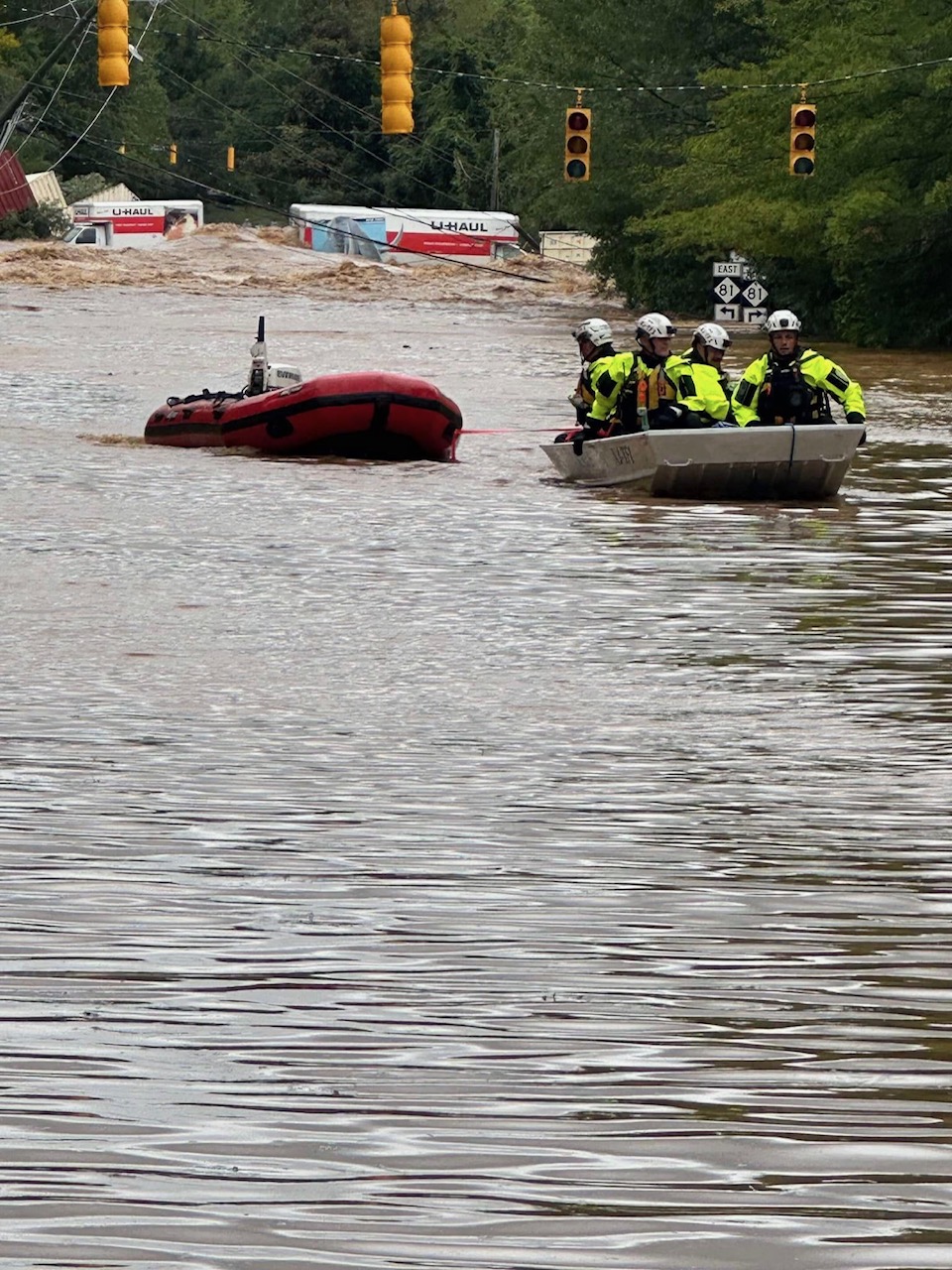
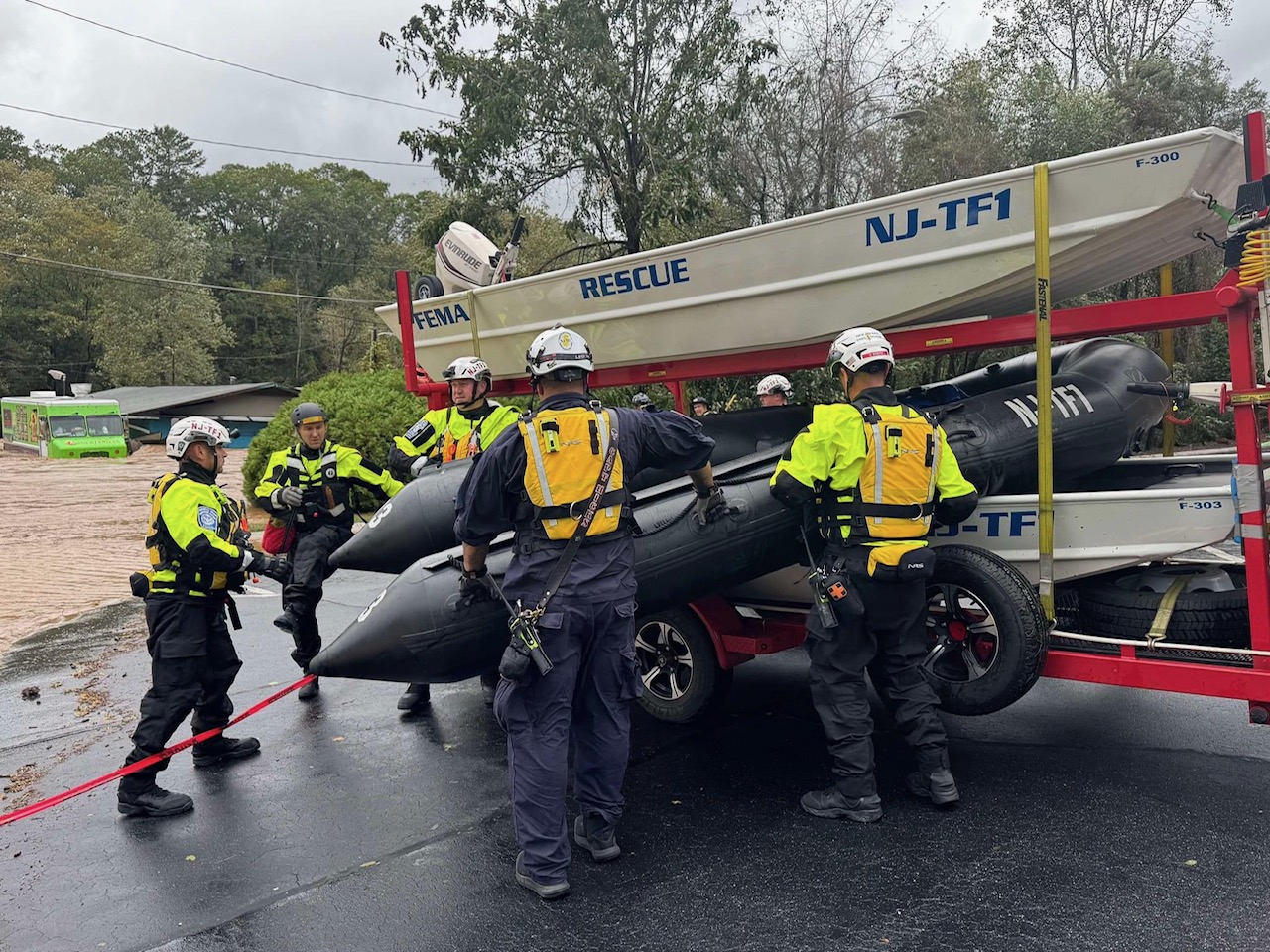
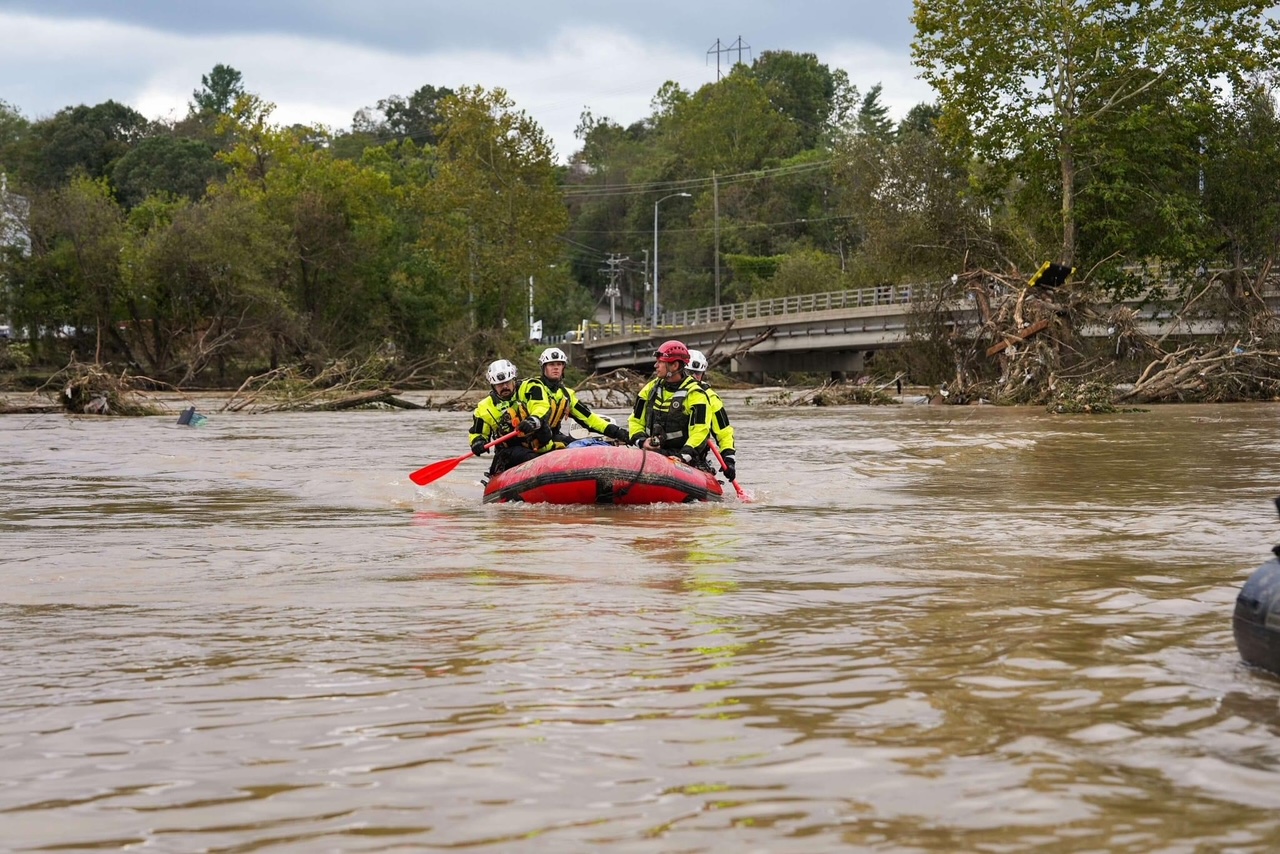
Joe: The planning group and our upper-level managers got together with the Asheville Fire Department, and we responded out with them to various calls, they had a couple of chiefs and captains assigned just to us because we don’t know the area. Roads are blocked by trees and flooding, we don’t know how to get around so the guides figure that out. That morning, I was on the “water” side, the “collapse” side of the team stood by at the hotel with their equipment. A couple of representatives went down to the fire headquarters to coordinate with them so they would know our capabilities. We divided into two groups with our boats and the Asheville boats, and then each had a fire captain escorting us around, and who monitored their radio frequency.
Our group saved a couple of people who were washed away, and another woman who basically rode her house down and then it got destroyed when it hit a bridge. She was in the house, then on top of the house, and then she found herself in the water, finally on top of an overseas container that was pinned up against another bridge further down the river. Now, normally this river was not very wide and only feet deep. This event caused it to rise up 28 feet and way over its banks.
The other boat crews were literally picking people up off the third story of their condos. They found themselves chasing houses down to make sure no one was in there, before they came to a bridge or other obstacle to crash into it.
Me: And you don’t even know what other debris could be underneath the water.
Joe: Not really, So, that was the first day, and then the water started going down.
Me: How long did you work that day?
Joe: Really only from daylight to nighttime. Because then it is too dangerous, and the water had started receding by then. The next day was a lot of walking around in the mud, as well as some boat action in the water. Now we had both halves of the team, since the tornado threat was over, the structural collapse side was available, and we had the full 80 people out, working on two different sides of the river, basically looking for people who are possibly stuck in trees, cars, still looking for live victims. We found some. Same with day 3,4,5….
Me: Does that ever get routine?
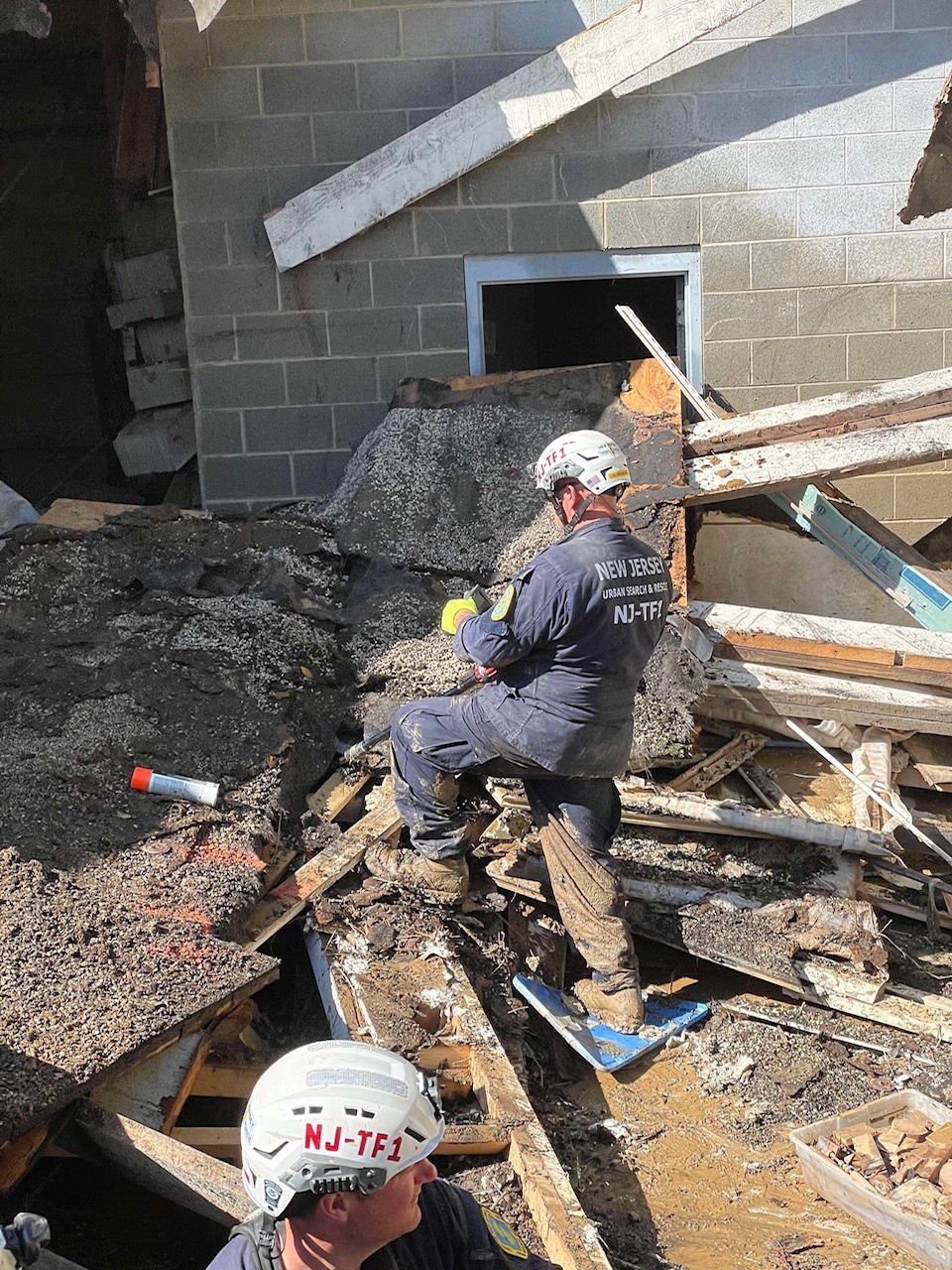
Joe: No, but we get better at it. [Laughs]. Those are the days of methodical searches. Land based, a lot of walking, working with the dogs. The dogs would hit on something, and if we believed that there was someone or something in there, and if it was a pile of sticks or debris all jammed up, we would have to take all of that apart. The team is really good at that. We’ll work with heavy equipment, as well as with saws, axes, and pry bars. People from the hazmat component will be sent out with the various squads to assist, but another bunch of us will stay back, because everybody comes back filthy. You don’t want to bring all of the oils, and nastiness and all the stuff they’ve been walking/slogging around in back to where you live in the hotel. All of that is happening miles away from where we sleep.
I was in the group in charge of cleaning and deconning everybody, and deconning the equipment, because you really need to clean everything everyday. You can’t let it build and build and build. If we didn’t by day four someone may be using a saw that is just covered with nasty stuff (technical term). We’re not talking just about chemicals, we’re talking about possible biological or radioactive filth.
Me: Can you describe how the fact that there was no water available to you was impactful to this process?
Joe: We lost water at the hotel too, when a dam burst, it took out the water plant. For six days, back at the hotel we filtered the water from the pool, so we were able to have showers – that was a luxury. (Not hotel showers…) We were without power for three days – which is not bad. But I’ll take a soft bed without power over sleeping on a cot any day.
Me: What about food?
Joe: Food was not a problem. Our logistics guys and our managers would drive to the Waffle House, like, four towns away, but they managed to get 80 meals to go! Other times they would come back with food and we would grill, or we always had the MRE’s, which we travel with. We are set up to live for 72 hours without any help. We have our own water and our own food. So this time with beds and waffle house meals, it was easy.
Me: So…Waffle House was open. [Laughs]. You know, Shannon says there is some TikTok barometer about the Waffle House being open in areas of Natural Disasters.
Joe: Yes, Waffle House is always open. If the Waffle House is closed, and Jim Cantore is your neighborhood, things are bad. And yeah, this time, we had a lot of Waffle House meals.
Me: Sometimes people ask me if they can send things to you, or help out in some way. I usually direct them towards giving money to the relief funds appropriately, but is that the best route?
Joe: We are well taken care of. State and Federal Taxes support our team and we’re supported by the State of NJ Office of Emergency Management as well as Federal Emergency Management Agency. Also – when we have to be, we are very resourceful. We’ll make something work out of almost nothing, because people are very clever on our team.
Me: What about communications? Obviously there was no cell service or communications after the storm hit.
Joe: We travel with a communication component. The communications team are technical people who set up our own communications – we have our own comm truck, we’ll tie into Starlink, or we’ll tie into AT&T, or whatever FEMA has set up. We can talk to people on our radios, and if I can’t use my personal cell phone for four days, it’s not a problem if something happens. If you have to get a hold of me, there are channels for you to do that.
Me: Yes, I just talk to Kerry. [Laughs].
Joe: Yes, Mike is a boss so he had a satellite phone. Right.
Me: So, I never worry tremendously because there are two things you have told me that I always remember, and repeat to myself – and these help me in regular life too. One is that you are on a team. You are never by yourself, and all of you look out for each other. I recognize some freak thing could happen, but I choose not to think about that. The second thing you have always said is that “It’s not my emergency.”
Joe: Yeah, I recognize that attitude sounds kind of callous. But it enables us to do our job, right? You have train your mind to step aside to think logically and critically.
Me: Is there anything that could prepare you to see a house coming down the river like that?
Joe: People on the team were asking me, as someone who has a lot of flood experience, including Hurricane Katrina, Hurricane Florence, Harvey, those responses – have you ever seen anything like this? The answer was “No. Nobody has seen anything like this since the Johnstown Flood of 1889”, you know? A wall of water that came down like that and just took everything with it, and then brought the remnants of that town down and smashed into other towns as it went. We didn’t even get to see Chimney Rock, there was no way for us to get there. Also, there was enough work for us to do where we were.
Me: Was there anything you could have done to train for that?
Joe: I oversee the water training for the team and I do my best. They did great. They performed some heinous rescues in heinous conditions. I try to challenge them in the Delaware in the spring, and last week I had them out in little boats with 25 horsepower engines in 10 foot seas outside of Barnegat Inlet. [Laughs]. If we had to cross Pamlico Sound after a storm in North Carolina, they could do it. Nobody flipped any boats over, so we are doing great.
Me: Will you adjust any of your training from this? I mean, there may not be another 1,000 year flood in your liftetime, but…
Joe: A few things. Everybody I know who is involved in the National Weather Service says I’m in a good line of work. Storms like this are going to keep coming, and the indicators say this is going to become a norm. The 100 year, the 500 year flood – we’re going to have to alter our thinking on that.
Me: What about the disinformation that was being spread? (That there was no Federal government response in NC). Does that affect you in any way?
Joe: Not at all. At the time and in the moment, we don’t have any internet, we’re not watching the news, and our people at home are really good about not giving us bad news.
Me: True – Even though we’re all outraged in our own way. And you didn’t hear anything from people there?
Joe: No. Everyone was very glad that we were there. You don’t even have time to think about that, we’re busy doing our work. We have our briefings, do our work, and then have another briefing at night.
Me: So, in effect, it doesn’t impact you,
Joe: No. And remember that, FEMA will warn about disasters, send USAR Teams to them, but is really set up to help you out after the disaster. During our searching after the flooding, there were various FEMA groups arriving. Teams are searching different zones, there is great technology now to log and report data. We will check cars that have been abandoned in the flooding, tag it and mark it. This data goes back to Washington almost instantly. The planners then know what has been checked, and it helps them decide where teams are needed next. After day 1, FEMA is already getting information. Later, that info comes back to the City of Asheville in the form of money and resources, replacement of emergency equipment, or possibly help rebuilding the dam for the water or filtration plant.
We searched in hundreds of buildings, and 779 cars. There were a lot of piles of debris to disentangle. Planners take the info we and the other teams give them. They overlay pictures from the planes and helicopters with more data. This all helps FEMA planners know what has been covered.
Me: What do you do when you find deceased people?
Joe: We set up a temporary morgue, we remove them respectfully and contact the local agency’s medical examiner.
Me: You mentioned there is a medical team.
Joe: Yes, there are doctors, nurses and paramedics with us. They take care of any team member’s medical issues, gashes, cuts, things like that. They monitor and make sure we’re eating right and our mental health is coping. Should we find someone entrapped, the medics will aid the trapped victims as we are working to free them.
Me: People often say to me, when you’re not here, Oh, thank you for his service. I know they say this to you too, and you always say, you don’t have to thank me.
Joe: They’re just going to say it – it’s ingrained in our culture.
Me: You’re all very humble. That’s not a question…
Joe: Nobody is forced to do any of this. We’re all very committed and volunteered to do this job. You know how many hours I put into it, all the guys do the same.
Me: I always thank people, and generally say It’s a higher calling. There are so many good people who dedicate a lot of time to this. People are appreciative. How do you think about this in your “retirement”? [Laughs]
Joe: [Scoffs] Well, I just don’t go to the one job anymore.
Me: For you, How did this compare to Hurricane Katrina?
Joe: This was worse than Katrina. I have pictures from Katrina where we saw a Box Truck, a refrigerator truck, up in a big Cypress Tree. It was washed by the storm surge in the Bayou. We didn’t arrive there until day 8 after the storm. The damage had been done, we weren’t there during the event. This one, we actually saw the trucks go into the trees. We were there during the event.
Me: Did you know how bad it was when you were in the hotel?
Joe: We had pre-staged in worse hurricanes. But by the time this got up to where we were it was a Cat 1 hurricane or tropical storm winds. We were 4 miles outside of town, so we didn’t see the river flooding from there.
Me: If Asheville hadn’t been hit, would you have gone somewhere else?
Joe: We probably would have been sent somewhere else and assisted with search and rescue.
Me: I am sure the town of Asheville is immensely grateful that you were there, and for all your work.
Some facts: New Jersey Task Force 1 (NJ-TF1) was activated as part of the National Urban Search & rescue (US&R) Response System and deployed to support rescue and recovery operations in the aftermath of Hurricane Helene. This team, deployed as a Type 1 unit, included 80 highly trained members, three tractor-trailers, two box trucks, five F-450 utility vehicles, two crew carriers, an F-250 towing vehicle, two passenger vans, two utility terrain vehicles, and a fleet service truck. Additionally, a specialized water rescue component, comprising six boats with trailers and a water support trailer, enhanced the team’s ability to respond to flood-related emergencies.
They are dedicated professionals who are actual MacGyvers (my own description). They can handle anything that comes their way. New Jersey, and all the States that interact with them in Natural disasters, are grateful for them.
A couple of resources if you want to know more about the team, the website is https://www.njtf1.org/
A Video produced by CBS covering Hurricane Helene: https://www.cbsnews.com/philadelphia/news/hurricane-helene-new-jersey-search-and-resue/
Follow them on Social Media: https://www.facebook.com/READYNEWJERSEY Instagram: @readynj




















 One Leg Up